
The business framework theory

The Philosophy Behind The Omnigoal

At the core of The Omnigoal lies a deep commitment to understanding business and organisational challenges through the lens of systems theory, underscoring a holistic approach that is both comprehensive and interconnected. This model integrates complex components into a unified framework, demonstrating how individual elements within a business do not operate in isolation but are part of a larger, interdependent system.

The Philosophy Behind The Omnigoal

One way in

The framework as a person

Eight cores is an abstract thing to be handed on a first reading. So here is a way in that costs nothing to try: read the whole framework as one person. Everything a business has to think about, a person has to think about too — and nobody would seriously try to sort their life out by working on one of these eight and leaving the other seven alone.

  1. 01

    Goal Core — what you are actually trying to do.

    A person has some reason they get up in the morning, and underneath it the things they want this year and the things they want in ten. Most people carry the second without ever having settled the first, which is why the goals keep changing shape. A business does exactly the same and calls it a change of direction.

  2. 02

    Business Core — what you have to work with.

    Your health, what you know how to do, the money in the account, the people you can call on, the habits and systems that get you through a week. It is the least romantic of the eight, and it is the one that quietly sets the ceiling on the other seven.

  3. 03

    Brand Core — how you come across.

    How you dress, how you speak, what you are known for, and what people say about you once you have left the room. You do not control it; you only influence it. The gap between how you see yourself and how others describe you is where nearly all the useful information sits.

  4. 04

    Vision Core — who you are, and who you are trying to become.

    Not the goals but the person underneath them: where you are heading, what you actually do with your days to get there, and the few things you will not trade for any of it. Written down, those three are called a vision, a mission and a set of values. Left unwritten they still decide everything, just less predictably.

  5. 05

    Market Core — the world you are in.

    Who else is around, who wants the same things you want, what has changed lately, and where the openings are. A person who never looks up from their own plans is doing what a company does when it stops watching its market: carrying on with a picture of the world that was accurate a while ago.

  6. 06

    Data Core — what you have noticed, and what you remember.

    What actually happened, as distinct from what you would prefer to remember happening. Anyone who keeps no honest account of their own decisions repeats them, and is surprised every time. A business has the advantage here — it can write things down — and it still manages to remember the version that flatters it.

  7. 07

    Omni Core — what it is like to deal with you.

    Not what you meant, but the actual experience of the people who matter most: whether you answer, whether you follow through, whether it is easy or a small ordeal. For a business those people are customers. For a person they are the handful whose opinion genuinely costs something.

  8. 08

    Time Core — how the hours actually get spent.

    What you do first, what you have now postponed four times, when to move and when to wait. Everything above this stays a wish until it meets a calendar — and a calendar is a document about priorities whether or not anyone meant it to be. What is missing from it has been decided against, quietly.

This is an analogy, and an analogy is for getting hold of something, not for proving it. A business is not a person: it is a lot of people who do not always agree, it can be sold or split in two, and there is no single head in it to change its mind. Push the comparison and it gives way at exactly those points.

What it is good for is the part that is hardest to see at the start — that the eight are not eight departments to be handed out, but eight sides of the same thing. Neglect one of them for a year and the trouble rarely stays where it started. Someone who stops sleeping does not have a sleep problem for very long; they have a work problem and a problem at home. Companies do the same thing, and usually give it a different name.

See the eight cores in full

Philosophical foundation

Holistic business framework

Systems theory

Together, the systemic ontology and iterative epistemology form the philosophical backbone of The Omnigoal, establishing it as a holistic model rooted in systems theory. This foundation not only supports a comprehensive understanding of business dynamics but also enhances the capability to devise strategies that are robust, adaptable, and aligned with the intricate realities of organisational operations.

Systemic Ontology

The Omnigoal adopts a systemic ontology, viewing organisations as cohesive systems. This perspective recognises that every decision, action, and outcome is not merely a standalone event but a component of a network of interrelated activities. By acknowledging the systemic nature of business, The Omnigoal ensures that strategies are developed with an awareness of the broader impacts, fostering decisions that enhance overall system efficacy rather than isolated parts.

Iterative Epistemology

Knowledge within The Omnigoal is developed through an iterative process. This approach to epistemology emphasises learning through cycles of planning, action, observation, and reflection. Each cycle builds upon the last, allowing for continuous adaptation and refinement based on real-world feedback and changing conditions. This iterative learning process is crucial for staying responsive and agile in a dynamic business environment.

Mixed methods methodology

The Omnigoal adopts a mixed-methods approach, integrating qualitative and quantitative research to provide a comprehensive view of business landscapes. This methodology balances in-depth, contextual insights with the scalability of quantitative data, aiming to deliver nuanced strategic support suitable for diverse challenges.

Methods for demands

The Omnigoal employs a variety of methods, selected based on the particular demands of each task. This flexibility ensures that the most suitable tools are used to address the unique challenges presented, enabling the application of the model to deliver practical and effective solutions.

Holistic business understanding

The intended result of The Omnigoal is to foster a holistic business understanding that can significantly enhance business development and optimisation. By synthesising insights from a range of methods, the model seeks to equip users with a comprehensive view of their operations, aiding in making informed decisions that drive growth and operational efficiency in complex business environments.

Navigating complexity with a pragmatic approach

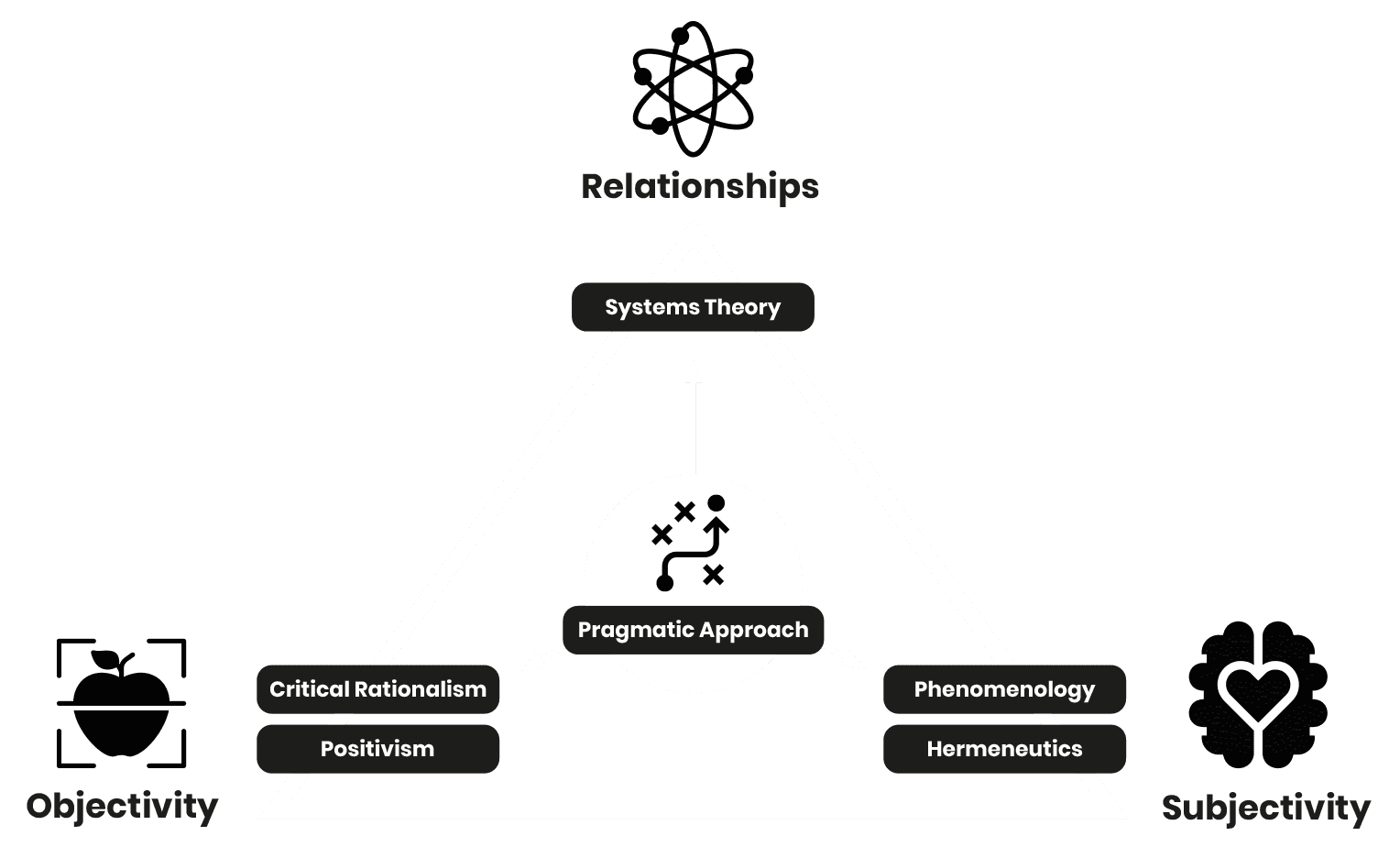
The Omnigoal embraces a pragmatic approach to business strategy, grounded in a philosophical framework that dynamically integrates three key perspectives: Relationships, Objectivity, and Subjectivity. Central to these perspectives is the pragmatic approach, which acts as a flexible guide, allowing you to adapt and apply the most appropriate philosophical lens based on the specific challenges and contexts of your business. This model encourages a balanced, informed approach to strategy development, ensuring that your business moves forward with both analytical rigor and creative insight.

Relationships, objectivity and subjectivity around a pragmatic approach
Relationships between the parts of a business

Relationships

(Systems Theory)

This higher perspective views your business as part of a larger system, emphasising the importance of understanding how various elements interact within this network. Systems Theory helps in mapping out the complex web of relationships that affect and drive your business, providing quantitative results that can be qualitatively explained.

Objectivity as one of the three philosophical positions

Objectivity

(Critical Rationalism, Positivism)

The focus is on grounding decisions in empirical evidence and rational analysis. This approach values data-driven insights and objective criteria for making strategic choices, ensuring that your decisions are well-founded and verifiable.

Subjectivity as one of the three philosophical positions

Subjectivity

(Phenomenology, Hermeneutics)

This angle appreciates the subjective experiences and interpretations that influence business contexts. It emphasises understanding the deeper meanings and narratives that shape customer behaviour and market dynamics.

The foundation of single-pointedness

At the heart of The Omnigoal framework lies a fundamental principle: single-pointedness precedes creation. This core belief emphasises that having a clear, focused, and singular goal is essential before any successful creation or strategic implementation can occur. The highest singular focus within the entire Omnigoal, which is inside the Goal Core, is the purpose.

Single-pointed focus as the starting point of strategy

The essence of focus

In The Omnigoal, the Goal Core represents this singular focus. It is what the other seven are arranged around, in the same way a person’s reason for doing anything is what their work, their habits and their choices end up organised by. This single-pointedness aims to align every strategic initiative, operational decision and brand development effort with the overarching purpose of the organisation. At this point, only the qualitative aspect (symbolised by a circle) is considered.

Building a business strategy on a strong foundation

Building on a strong foundation

Without a clear and defined goal, efforts can become fragmented and directionless. The Omnigoal framework advocates for a strong, purpose-driven foundation, where the Goal Core serves as the starting point for all business development and strategic planning. This foundation is achieved by including SMART goals (short, long, tactical, strategic), resulting in both a circle (qualitative aspect) and a square (quantitative aspect), signifying that the purpose can be quantitatively measured.

The path from focus to creation in business development

From focus to creation

By establishing single-pointedness, The Omnigoal framework helps businesses to create with intention and precision. This focused approach aims to ensure that resources are utilised effectively, efforts are synergised, and the path to achieving the business's goals is clear and attainable. Everything surrounding the Goal Core can thereby be seen as multiple circles and squares, representing the constellation of all the qualitative and quantitative data in The Omnigoal. Together, these circles and squares form the comprehensive essence of the business.

In essence, The Omnigoal suggests that true creation and success begin with a clear, unwavering focus on a singular goal. This principle is the cornerstone of the framework, guiding businesses towards purposeful growth and strategic excellence by integrating both qualitative insights and quantitative metrics.